Why does no one make rubber strap merch nowadays?
Rubber straps (ラバーストラップ) used to be a staple of anime merch, but they've fallen off bad in the past decade. I believe this is mostly due to manufacturing costs, but oshikatsu trends also play a big part.
Production costs
Anyone can produce acrylic charms quite easily nowadays. Some manufacturers offer MOQs as low as three pieces at only a few dollars per piece, making acrylic merch very accessible to individuals and very appealing to anime companies.
Rubber strap MOQs are much higher, usually at least 50~100 pieces. Unlike acrylic merch, rubber straps require the production of a mold. The process is similar to manufacturing enamel pins:
- Creating a vector file based on the artwork
- Producing a metal mold
- Injection-filling each color into the mold
- Printing the logo or copyright notice on the back
Mould production costs a lot in of itself, separate from the rubber strap production. While straps aren't that expensive per-piece, they'll always have a higher MOQ to justify the cost of creating the mold—and always require a higher commitment to production costs in turn.
Creation constraints
Because of the production process, rubber straps are limited to a couple of colors and solid lines. This greatly restricts the kind of artwork they can portray; rubber straps are almost always simplistic chibi artwork.
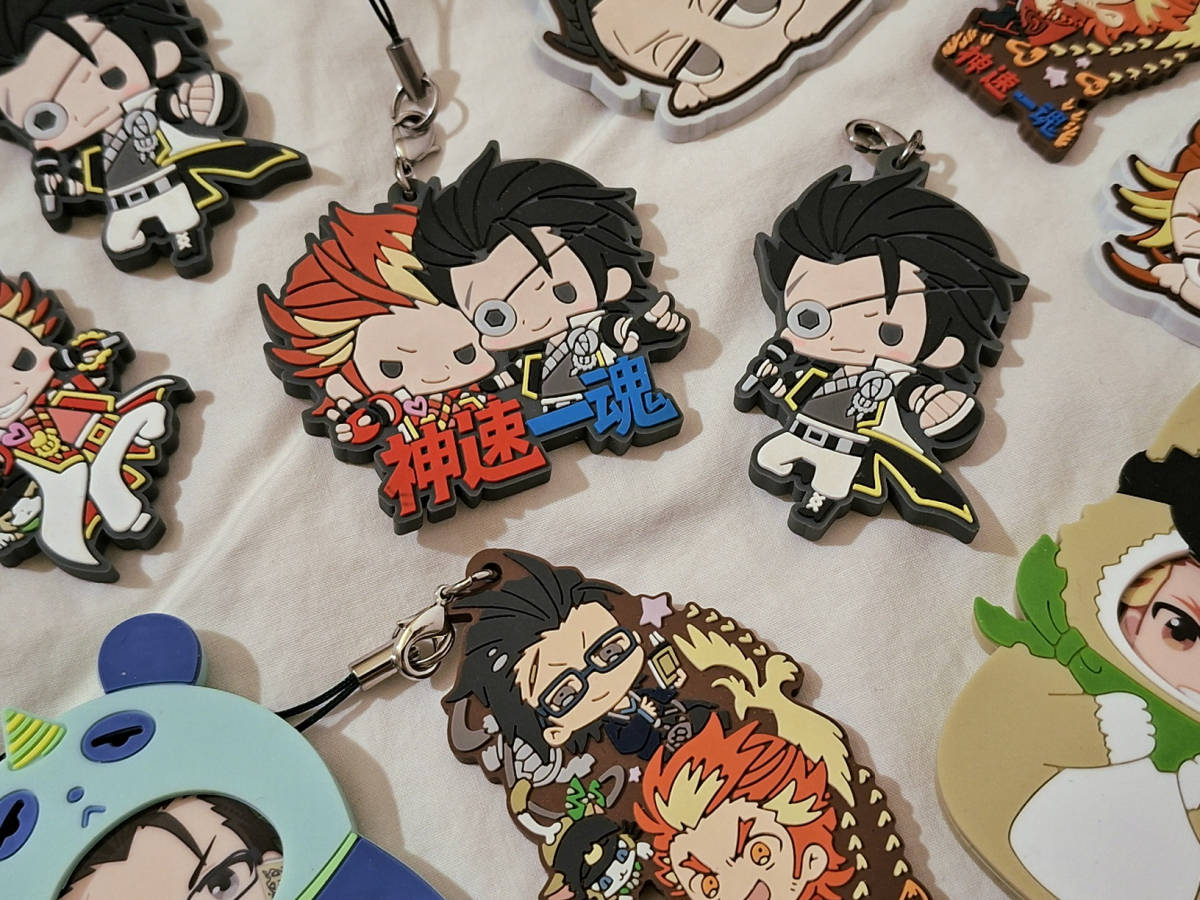
Rubber straps always require new artwork or at least new art processing to vectorize the design. Colors selection is limited to what the company can procure1 and color quantity is limited to how many nozzles the injection machine has.2 That means that creating art for rubber straps requires more specialized production knowledge that anime companies might not want to invest in. Besides, most companies prefer to just reuse existing art for merch these days—it's cheaper and fans already like those illustrations anyway.
Defects and bootlegs
Back when rubber straps were more common, you'd often see factory rejects being sold on Taobao. These were official pieces of merchandise that didn't pass a quality check and remained with the manufacturer. However, profits from these goods went to the manu, not the IP holder (the anime company).
In the same vein, rubber straps were easy to bootleg by duplicating a mold. This would often end in mold errors, wrong colors, no logo on the back, incorrect strap type... It's easy to tell when a bootleg is a bootleg and not just a factory reject. That being said, while rubber straps were easy to counterfeit, acrylic charms are even easier since they're just a single image.
However, acrylic charm manus are far more widespread, with options in Japan, UK, and the US. Anime companies can leave their artwork with manus that have to comply with local rules, speak the same language, they can visit in person, etc. So the risk of artwork being sniped for bootlegs is probably lower.3
Consumer trends
I say 'consumer trends', but it's all kinda consumers and companies playing off of each other. IMO one of the biggest parts of this is the massive boom in character-focused series. That's stuff like gacha games and joseimuke series where the plot is secondary to you having a favorite character that you collect all 6 billion cards/outfits/titles/plastic objects of. But even traditionally plot-focused series have had a massive uptick in merch production because oshikatsu is just so huge right now.
So back to production costs, acrylics are a lot cheaper to make than rubber straps at low MOQ, but rubber straps also have the perception of being cheap (unlike enamel pins, which share a similar expensive initial production process). So you can't charge 1700 yen for a rubber strap but you can easily do that for an acrylic stand.
And stands are the big thing that everyone wants right now. People love taking oshikatsu food photos with their acrylic stands and showing off their massive standee collections at home.
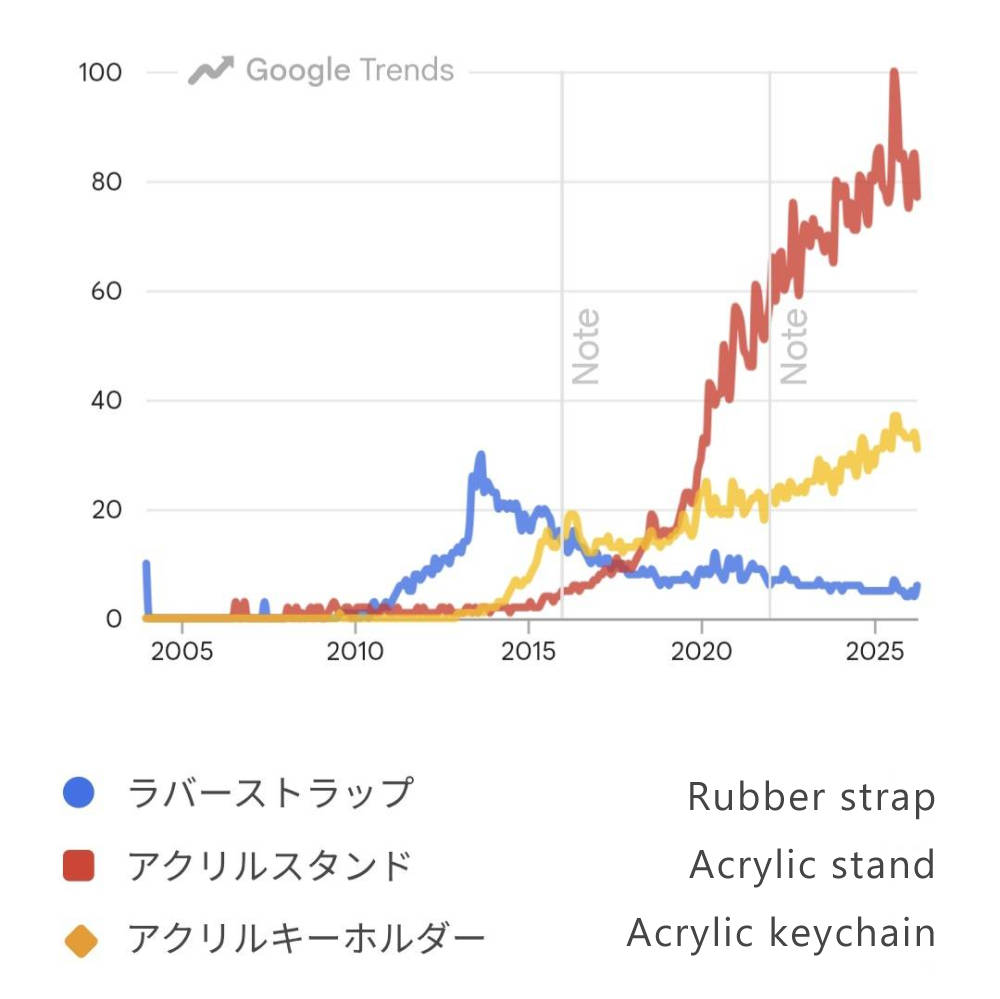
Back to creation constraints, the flexibility of creating acrylic merchandise means that you can very easily make merch that fulfils this desire just by reprinting some character promo art or gacha game card illustration. Fans can look at the characters' pretty faces and complex outfits instead of a simple chibi.4
That's especially important as character designs have gotten increasingly complicated in the VTuber era. Multiple hair colors, gradients, etc. Speaking of VTubers, many are not quite corporate, but not just a fanartist or indie artist doing their own thing—perfectly benefiting from the low cost and MOQ of acrylic merch.
The higher cost and size of standees does mean you can't sell them through gachapon. But that's fine since so many anime companies have switched to offering online preorders instead. Instead of making gacha or store sales and equally producing merch for all characters regardless of their actual popularity, they can ensure people get the characters they like and that they don't overproduce on characters no one gives a fuck about.
Finally new phones don't have earphone jacks. That might seem random, but it was a use case specifically suited to rubber straps because of their softness and lightness. Most Japanese acrylics use single-board printing, so they're a lot more fragile than rubber straps—it's easy for the art to get scratched off, so people don't want to use them on their bags and phone cases without a protective plastic cover. For their plastic.
I assume this is based on Pantone and that manus charge based on number of colors.↩
Rubber straps seem to always be made by machine, but some hard enamel pin companies use humans for the injection-filling process.↩
It looks like Japan has some rubber strap manus now as well, but at least back then it was known that everything was done in China. These days there's a lot more officially licensed Chinese merch of Japanese series, so stuff isn't necessarily bootleg if it's in Chinese instead of JPN. But this probably doesn't apply for your local mall anime store.↩
I think that plush or nui have taken the role of 'cute thing you can carry with you' instead, but people are more fond of them because they're, well... plushies... You can dress them up and stuff.↩